
The person taking minutes is the person least able to contribute. That trade-off is so normal it stops being questioned — until a decision gets made while the note-taker is still typing the previous one. Recording plus transcription removes the trade-off, and an AI write-up afterwards turns the transcript into the thing people actually wanted: decisions, owners, and dates.
FOR MEETINGS
Be in the meeting, not taking minutes.
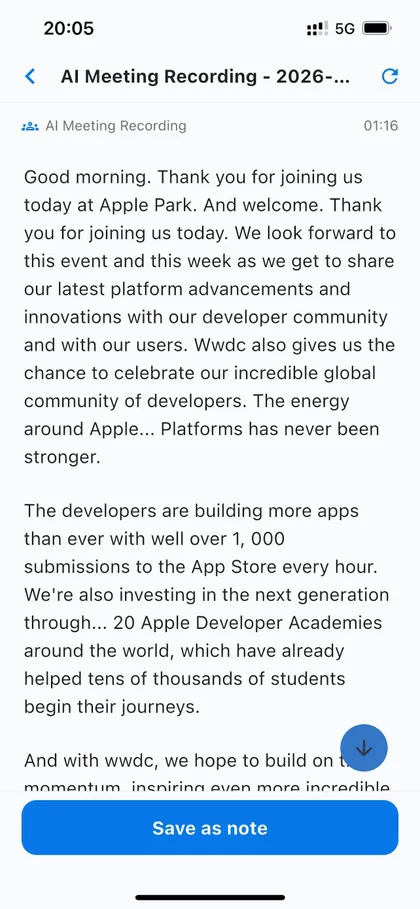
Record, follow the live transcript, get an AI write-up with decisions and action items, and search past meetings by what was said.
JOBS TO BE DONE
What you are trying to get done
Record and follow along
Start the recording and watch the transcript build. You can look someone in the eye and still have the exact wording of what they committed to.
Turn the transcript into a write-up
After the session, AI meeting write-up refines the transcript and speakers and produces a meeting summary inside the note. Available on Plus and Pro.
Extract decisions and action items
Ask for the decisions, the open questions, or what you personally agreed to do. The answer is drawn from the meeting note, not from a general model's guess.
Find the meeting where that was agreed
Search across past meetings by the phrase you remember. The recording library keeps the audio for the moments where wording matters.
IN PRACTICE
How this works across a session
01
Before
Tell participants you are recording and get their agreement. Put the agenda at the top of the note so the write-up has structure to attach to.
02
During
Let the transcript run. Type one line whenever a decision lands — a human marker in the middle of machine capture is worth more than either alone.
03
After
Generate the write-up, correct the two or three things it misread, and send the decisions to the people who were not there.
What a good meeting note actually contains
Almost nobody rereads a full transcript, and almost everybody rereads a decision list. A meeting note earns its place when it answers three questions without being read end to end: what did we decide, who is doing what, and what is still open.
The transcript is the evidence layer underneath that. It matters when a decision is disputed a month later, and it is close to worthless as a daily artefact. Keeping both — a short structured summary on top, the full text underneath — is what makes the note survive contact with a busy week.
- Decisions, with enough context to be understood out of the room
- Action items with an owner and, where it exists, a date
- Open questions, so the next meeting has a starting point
- The full transcript, kept but not read by default
Recording responsibly
Recording a conversation carries legal obligations that differ by country and by state, and social obligations that are the same everywhere. Say that you are recording, say what the recording is for, and stop if someone objects.
This is not a formality. A meeting where one participant is uncomfortable produces worse information than one with no recording at all, so consent is a quality question as much as a compliance one.
Why the summary should stay next to the source
Summaries in one tool and recordings in another is how organisations end up with decisions nobody can trace. When the write-up lives in the same note as the transcript that produced it, checking a claim is a scroll rather than a search across systems.
It also makes correction cheap. If the model misattributed a commitment, you fix it in the note that everyone reads, and the corrected version is the one that circulates.
Worth knowing: Follow local law and obtain consent from every participant before recording. Transcription quality varies with language, environment, device, and network. AI meeting write-up is a Plus and Pro membership benefit.
Where to go next
Be the first to know when MemoFlow is ready.
No newsletter cadence—only the launch and essential product information.