
Research rarely arrives in one format. A useful finding may begin as a line in an interview, a paragraph in a paper, a photographed archive page, or a thought written between sessions. The job is not merely to save each item; it is to preserve enough source context that a claim can still be checked when the draft changes months later.
FOR RESEARCHERS
Keep the evidence close to the idea it supports.
Capture interviews, papers, screenshots, and working notes in one searchable research trail, then use AI over only the notes you select.
JOBS TO BE DONE
What you are trying to get done
Preserve interviews
Record with consent, keep the audio, and turn the conversation into text that can be searched and quoted carefully.
Capture printed evidence
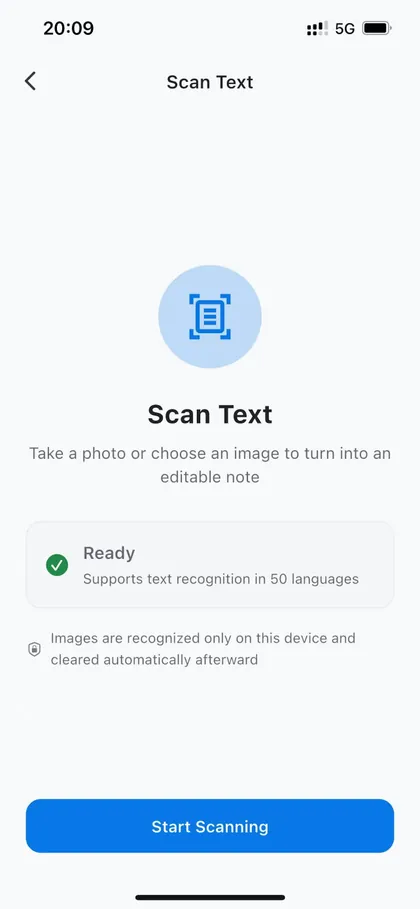
Use OCR to bring a paper, slide, or screenshot into an editable note without losing the original image as context.
Connect material to questions
Organize notes around research questions and projects, not only around where each source came from.
Retrieve the supporting passage
Search notes, transcripts, and recognized text together when you need to verify a claim or revisit an earlier theme.
IN PRACTICE
How this works across a session
01
Capture
Create one source note per interview, paper, or observation. Record provenance immediately: author or participant, date, location, and consent constraints.
02
Distill
Add a short summary, candidate themes, and exact passages worth returning to. Keep interpretation visibly separate from source material.
03
Synthesize
Select the relevant notes for AI, ask a narrow question, and verify every important answer against the underlying note, transcript, or image.
A research note needs provenance, not just content
A paragraph without its source is a future citation problem. Put the source, capture date, page or timestamp, and any usage restriction at the top of the note. For interviews, record whether quotations may be attributed, anonymized, or used only as background.
Separate observation, quotation, and interpretation
Use visibly different blocks or headings for what the source said, what you observed, and what you think it means. That boundary makes later synthesis faster and reduces the chance that a polished paraphrase is mistaken for evidence.
- Source: exact quotation or faithful transcript excerpt
- Observation: what happened or what the material shows
- Interpretation: your current explanation, including uncertainty
- Next check: the evidence that could confirm or disprove it
Where MemoFlow fits
MemoFlow is useful when the capture formats are mixed: an interview recording, photographs of pages, and typed field notes can all become searchable notes. AI can work over a selected set of notes, but it should support synthesis rather than replace source checking.
Good to know
Transcription and OCR can misread names, technical terms, handwriting, tables, and low-quality images. Keep original audio and images, and verify any passage that will support a published claim.
Worth knowing: Obtain informed consent before recording participants and follow your institution's data-handling rules. Verify quotations, names, page references, and AI-generated synthesis against the original source.
Frequently asked questions
Can researchers transcribe interviews with MemoFlow?
MemoFlow can record and transcribe conversations, while keeping the recording with the resulting note. Obtain consent and verify quotations against the audio before publication.
Can OCR replace manual checking of papers?
No. OCR speeds up capture, but names, formulas, handwriting, tables, and poor scans still require comparison with the source image.
How should AI be used with research notes?
Use a narrow set of selected notes for a specific question, then trace every consequential claim back to the source material.
Where to go next
Explore the product
No newsletter cadence — one email at launch, and only essential product information after that.