
A talk is dense, one-directional, and gone the moment it ends. Unlike a meeting, you cannot ask the speaker to repeat the definition — and unlike a document, you cannot skim ahead. That combination is why so much of what people attend leaves no trace, and it is exactly the problem transcription plus a reduction pass is shaped to solve.
FOR LECTURES AND TALKS
An hour of talking, reduced to what you needed.
Capture lectures, conference talks, and training sessions with a transcript, the slides attached, and a summary you will actually reread.
JOBS TO BE DONE
What you are trying to get done
Capture a long session without fatigue
Record the whole talk and follow the transcript. Attention over sixty minutes is a limited resource; spend it on understanding rather than stenography.
Keep the slides with the words
Photograph a slide and OCR puts its text into the note, next to the passage where it was discussed.
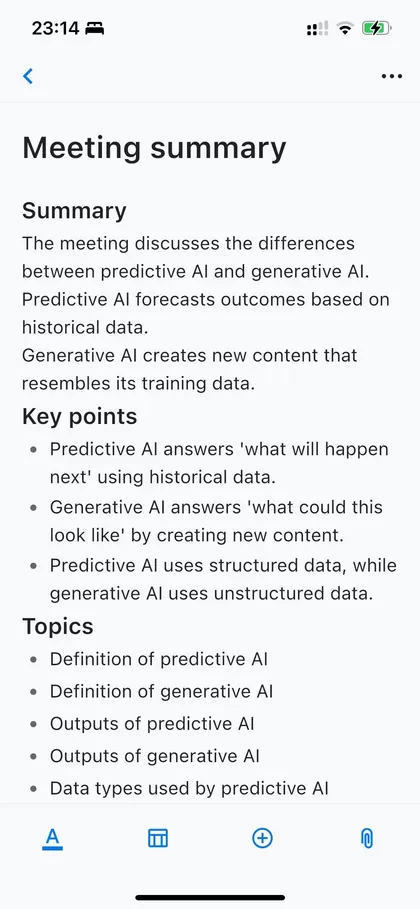
Reduce an hour to a page
Ask for a summary of the session, then cut it to the three things you will actually use. The reduction is the point.
Retrieve it months later
The transcript is searchable, so a half-remembered claim from a conference in spring is findable in autumn.
IN PRACTICE
How this works across a session
01
Before it starts
Check whether recording is permitted — many conferences and training providers restrict it — and create the note with the speaker, title, and date at the top.
02
While it runs
Photograph slides as they appear rather than at the end, so the images land in the right place in the transcript. Add a one-line marker whenever the speaker signals something important.
03
Within a day
Reduce. Summarise, delete everything you will not return to, and write one paragraph in your own words about why the talk mattered.
Reduction is the step people skip
A full transcript of a talk feels like a result, but it is only a raw material. The value appears when an hour of speech becomes a page you can reread in two minutes, and that only happens if someone decides what to throw away.
AI can propose the reduction; you should make the final cut, because deciding what mattered is the part that puts the content in your head. A summary you accepted without reading is one you will not remember having.
- Summarise the session, then cut the summary in half
- Keep the passages you would quote; delete the passages you would skim
- Write one sentence of your own about why it was worth attending
Slides and speech are two halves of the same note
Slide decks carry the structure and the numbers; the talk carries the reasoning and the caveats. Separated, each one is much less useful — a deck without its commentary is a set of assertions, and a transcript without the diagram it refers to has a hole in it.
Capturing both into one note, with OCR making the slide text searchable, is what lets the material be understood later by someone who was not in the room, including your future self.
What to expect from transcription accuracy
Room acoustics, microphone distance, accent, and subject-specific vocabulary all affect the result. A large lecture hall with a distant speaker is a harder case than a seated conversation, and specialist terminology is where errors concentrate.
Plan for a correction pass on the terms that recur. Fixing a misheard technical term once, early, is worth more than any amount of careful reading later.
Worth knowing: Check the organiser's and the speaker's rules before recording a lecture, talk, or training session. Transcription quality varies with room acoustics, accent, and subject vocabulary.
Where to go next
Be the first to know when MemoFlow is ready.
No newsletter cadence—only the launch and essential product information.