
In a bilingual meeting, the person with the weaker language is spending most of their attention on decoding rather than deciding. The result is a conversation where one side contributes less than they could, and where agreement is often less solid than it looked. Seeing both languages at once shifts the effort from remembering what was said to responding to it.
FOR CROSS-LANGUAGE WORK
Keep a cross-language conversation moving.
Follow the original and the translation side by side, keep the session afterwards, and leave with meeting notes both sides can read.
JOBS TO BE DONE
What you are trying to get done
Follow both sides in real time
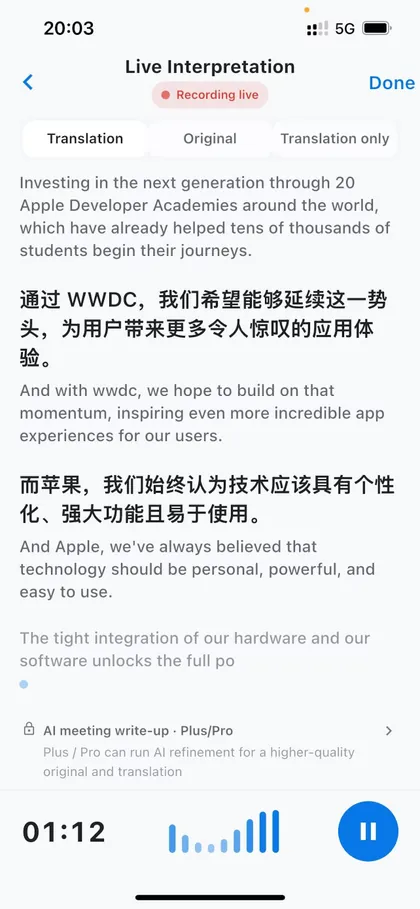
Choose the source and target languages and watch the original and the translation together, so you can check a phrase rather than guess at it.
Keep the session
The session is saved to your notes, so a discussion that happened across two languages leaves a single record.
Produce notes both sides can read
Summarise the outcome and keep the original wording nearby, which matters when a commitment was made in someone's second language.
Check what was actually agreed
Search the saved session later. Ambiguity in a cross-language meeting usually surfaces days afterwards, not in the room.
IN PRACTICE
How this works across a session
01
Set the pair
Pick source and target before the conversation starts, and tell participants the session is being captured and translated.
02
During the conversation
Read the translation to follow, glance at the original to verify. Where a decision is being made, slow down and confirm it in both languages.
03
After
Write the outcome in short, plain sentences. Short sentences translate reliably; long conditional ones do not.
Machine translation is a bridge, not a substitute for an interpreter
Automatic translation is genuinely good at the ordinary substance of a working meeting: status, logistics, technical description. It is much weaker at the things that decide outcomes — idiom, hedging, humour, and the difference between a polite refusal and an agreement.
For medical, legal, financial, or other high-impact conversations, use a professional interpreter. The right use of live interpretation is to make everyday collaboration workable, not to carry decisions that depend on precise wording.
- Confirm every commitment explicitly, in both languages
- Prefer short declarative sentences over long conditional ones
- Escalate to a professional interpreter when accuracy is consequential
Why the original should stay visible
A translation-only view hides its own mistakes. When the source text sits beside the translation, a participant who knows both languages can catch a mistranslation as it happens — which is usually the only moment it is cheap to fix.
Keeping both also makes the record honest afterwards. If a dispute arises about what someone agreed to, the original wording is what settles it.
Writing meeting notes people in two languages will read
Notes from a bilingual meeting are read by people with very different reading speeds in the language they are written in. That argues for structure over prose: a decision list, an owner per item, and dates written unambiguously.
Avoid idiom, avoid nested conditionals, and put the decision before the reasoning. These habits make notes clearer for everyone, and dramatically clearer for a second-language reader.
Worth knowing: AI translation can be inaccurate and should not replace professional interpretation in medical, legal, financial, or other high-impact situations. Obtain consent from every participant before recording.
Where to go next
Be the first to know when MemoFlow is ready.
No newsletter cadence—only the launch and essential product information.